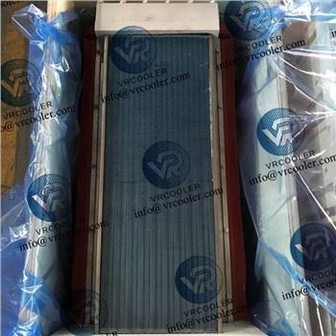
Why Use A Dry Cooler?
There are different methods of industrial cooling depending on the operator's preference. While some process temperatures can be optimally maintained using a conventional industrial cooler, other process temperatures require the use of alternative equipment such as a dry cooler.
Both thermoregulation tools can achieve similar results, but they operate by different mechanisms. This article will focus on the differences between dry coolers and chillers and help you determine the best fit for your cooling needs.
What is a dry cooler?
Dry coolers vs. chillers
A dry cooler is a cooling unit that uses air to achieve process temperature regulation. The cooling of a dry cooler is based on the principle of sensible heat removal. A typical installation requires the cooling medium delivered from the process in question to enter the dry cooler and exchange the accumulated heat with the air circulating inside.
The dry cooler is equipped with a fan that draws air from outside the cooler to maintain the heat exchange process. To ensure efficient process cooling, a suitable temperature difference must be maintained between the cooling medium and the air inside the dry cooler. A minimum difference of 5°C is usually sufficient.
Fluid coolers and dry coolers
A dry cooler is essentially a fluid cooler, which uses air (a relatively dry, non-liquid fluid) to complete the process cooling. A fluid cooler is more precisely a cooling device that uses a fluid (liquid or gas) to regulate the temperature of a process.
Dry coolers vs. chillers
Both dry coolers and chillers can be used in similar process applications to obtain optimum temperatures. However, just as there are differences between a cooler and a heat exchanger, there are also significant differences in the function of dry coolers and chillers. When used under the right conditions, each of these devices offers advantages.
With a dry cooler, heat exchange takes place by drawing in external air and circulating it over a pipe containing a cooling fluid (usually water or a water-glycol mixture). The cooled fluid is then circulated through a heat exchanger connected to the relevant process. The excess heat transferred to the coolant is then returned to the dry cooler and the cycle starts again. It is important to note that the dry cooler does not have a standard refrigeration unit to cool the circulating refrigerant. Instead, it uses a fan to draw in ambient air to cool its heated fluid medium.
Industrial chillers, on the other hand, include a refrigeration unit (usually in combination with a heat exchanger) in their cooling unit. The cooler uses coolants/cooling fluids which can be cooled by air or water in the associated condenser. This is the basis for distinguishing between water-cooled and air-cooled water chiller variants.

Dry cooler system design
A typical dry cooling system is designed as a two-unit system consisting of an outdoor and indoor section connected by a fluid pump.
Dry cooler with fluid cooler
The outdoor component is the dry cooler, while the indoor unit consists of the following components enclosed together.
Heat exchanger
Piped circulation coolant
An evaporator
A compressor
Advantages of using a dry cooler
The benefits of choosing a dry air cooler are as follows.
Easy to install and start up
Easy component separation allows the operator to save significant floor space for other equipment
Low overall operating costs after initial installation
Dry coolers do not require a continuous water supply, so there are no water supply and handling problems
Heat generated can be transferred directly to other processes, reducing energy waste and increasing overall efficiency
Dry coolers can be programmed to operate all year round, even in low temperature environments
Disadvantages of using dry coolers
Additional cost of additional components increases total set-up expenditure
Regular monitoring (or automatic chiller monitoring system) is required to ensure that the coolant level does not fall below the required level